
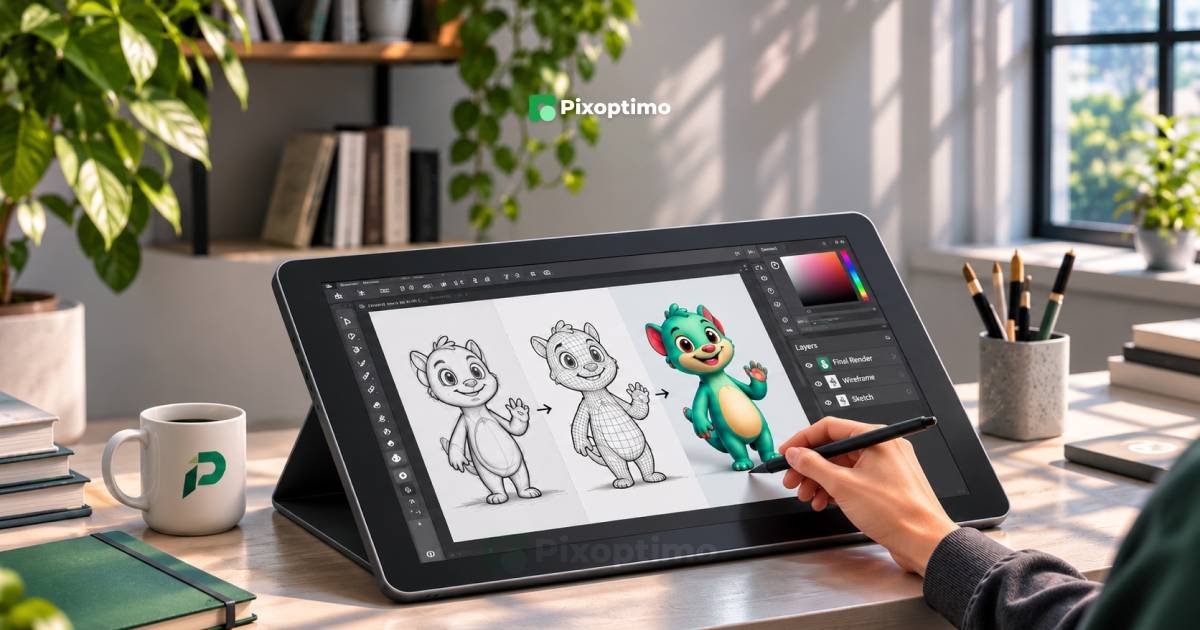
A brand can have a recognizable colour palette, a carefully selected typeface and a well-documented design system, yet still struggle to maintain visual consistency across hundreds of creative assets.
The problem becomes more complicated when generative AI enters the workflow. Ask a general-purpose image generator to create ten images for the same campaign and you may receive ten attractive results. But the characters might change appearance, the lighting may shift, the illustration style may drift and important visual details may disappear between generations.
Adobe and Disney are approaching this problem differently.
On November 9, 2026, the companies announced a multi-year partnership focused on developing proprietary AI models tailored to Disney’s creative properties. Through Adobe Firefly Foundry, the models are customized around Disney’s characters, environments and visual styles. Walt Disney Imagining is already using sketch-to-image and custom image-generation workflows to develop concept artwork and franchise-specific creative assets.
This development raises an important question for the design industry: Can a custom AI model preserve a brand’s visual identity better than repeatedly prompting a general-purpose image generator?
The answer is yes, under the right conditions. But the technology does not automatically understand a brand, guarantee perfect consistency or replace the people responsible for its creative direction.
Quick Summary
- Custom AI models: These are adapted to a specific brand’s visual assets, creative requirements and intellectual property.
- Adobe and Disney: Their November 2026 partnership uses Firefly Foundry to develop proprietary models around Disney’s creative properties.
- Visual consistency: Brand-specific models can reduce repeated character, style and appearance variations across generated assets.
- Sketch-to-image: Disney Imagineering is using models that transform hand-drawn concepts into rendered 2D concept artwork.
- Enterprise technology: The Disney arrangement is a tailored business collaboration, not a standard feature available to every individual Firefly user.
- Human creative control: Designers still determine the concept, evaluate results, correct mistakes and approve final artwork.
- Copyright matters: Training permissions, intellectual property rights, output ownership and commercial licensing need to be considered before deployment.
Why General-Purpose AI Image Generators Struggle With Brand Consistency
Most designers have encountered this problem when generating a collection of related images.
The first result looks excellent. The second is close. By the fifth attempt, the subject may have a different face, the background has changed, or the visual treatment no longer resembles the original artwork.
A general-purpose model is designed to respond to a wide range of requests. Its broad knowledge makes it useful for exploring unfamiliar subjects and generating different visual directions. However, that flexibility can become a disadvantage when a project requires a very specific visual identity.
Consider a fictional footwear brand preparing a seasonal campaign.
The creative team has already established:
- A particular illustration style.
- A consistent treatment of product photography.
- A defined colour palette.
- Specific lighting and background preferences.
- Rules for presenting its products and logo.
A general-purpose generator can follow these instructions, but the designer may need to repeat them for every generation. Even then, a text prompt does not guarantee that every image will reproduce the same visual characteristics.
The problem is not necessarily image quality. It is the difference between producing an attractive image and producing an image that belongs to a particular brand.
For a campaign containing a few experimental visuals, that difference may not matter much. For a global brand producing assets across advertising, social media, packaging, retail displays and digital experiences, it becomes a serious production concern.
What Is a Custom AI Model for Brand Design?
A custom AI model for brand design is a generative model adapted to work with a particular organization’s visual language, creative assets or production requirements.
Rather than relying entirely on broad visual knowledge and instructions supplied through prompts, the model receives brand-specific information during its customisation process.
Depending on the system, this can involve curated training images, fine-tuning, specialised model components or other methods of adapting a foundation model. The exact technical approach varies between platforms and enterprise implementations.
For a design team, the important distinction is the source of visual guidance.
A general-purpose model may know what a cartoon character, product photograph or architectural environment typically looks like. A brand-specific model can be adapted around the particular character designs, product details, environments and visual treatments that belong to an organization.
Think about a company with a recognizable mascot.
The model could be customized using approved character artwork from different angles, expressions, poses and situations. When the creative team requests another campaign image, the model has a more specific visual foundation to work from.
This does not mean it memories every image and reproduces it perfectly. Nor does it guarantee that every generated result will match the original design. It means the generation process has been adapted to a narrower, more relevant creative context.
That distinction is what makes custom models useful for established brands.
Adobe and Disney: A Real-World Example of Brand-Specific AI
The Adobe and Disney partnership provides a practical example of how this technology can move beyond experimental image generation.
Under their multi-year alliance, Adobe will provide access to technologies including Firefly, Firefly Foundry, Photoshop and Premiere, alongside dedicated engineering and research resources.
The central part of the agreement is the development of proprietary generative AI models tailored to Disney’s creative properties.
These models are intended to understand the visual characteristics associated with Disney’s characters, environments and creative worlds. The objective is to help creative teams develop ideas more quickly while maintaining the details that make those properties recognizable.
This is particularly relevant to Disney Imagining.
Imagining works on the design and development of experiences across Disney’s parks and other destinations. Its creative process involves more than producing attractive concept images. A visual idea may eventually influence physical environments, attraction layouts, architectural elements and engineering decisions.
A concept that changes significantly between design stages can create additional work.
Custom AI models provide a way to explore visual possibilities while keeping the creative reference closer to the intended property.
Sketch-to-image: Turning Early Concepts Into Rendered Artwork
One of the most interesting applications already in use at Disney Imagining is sketch-to-image generation.
The process starts with a hand-drawn concept. An artist might sketch an attraction environment, a themed structure or an early visual idea. The AI model then uses that drawing as a starting point for producing rendered 2D concept artwork.
The designer is not asking the model to invent an entire scene from a text description. The original drawing supplies visual direction.
This changes the relationship between the artist and the generator.
A rough sketch communicates composition, object placement and the overall structure of an idea. The model can help develop that starting point into a more polished visual, allowing the team to explore different treatments and directions.
Imagine a designer exploring several versions of a themed environment. The initial drawing establishes the layout. The team can then investigate different materials, lighting conditions, colour and visual details without redrawing the entire concept each time.
The resulting images are still concept artwork. They should not be confused with approved construction documents or technically verified engineering plans.
Custom Image Generation: Keeping Franchise Artwork Recognizable
Disney Imagining is also using a custom image model designed to produce on-brand, franchise-accurate creative assets.
This is where the brand-specific approach becomes particularly important.
A recognized character has established visual characteristics. Changing its proportions, clothing, facial details or colour treatment can make the result feel wrong, even when the image itself looks polished.
A custom model can be adapted around approved character references and the visual language of a particular franchise. This gives the generation process a more focused foundation than a general prompt alone.
For Disney, that approach can support creative exploration across its established properties while helping teams maintain a recognizable visual direction.
It is also important to understand what has actually been announced. The partnership describes these existing Imagining workflows and broader collaboration plans. It does not mean every Disney production, film or campaign has moved to AI-generated artwork.
What Does a Custom Model Actually Learn From Brand Assets?
The phrase “trained on brand assets” can sound straightforward, but there is more involved than uploading a folder of logos and photographs.
A useful customisation process begins with selecting the right creative material.
For a brand design model, that material could include:
Approved visual assets: Official illustrations, product photography, campaign artwork, character references and other material that represents the intended brand identity.
Visual characteristics: Recurring colour treatments, illustration styles, lighting approaches, textures, shapes and composition patterns.
Subject-specific details: Character proportions, product features, distinctive objects, environmental elements and other details that should remain recognizable.
Creative context: Information about how different assets are used, which visual variations are acceptable and which elements must remain unchanged.
The quality of the source material matters. A training collection filled with outdated logos, inconsistent campaign artwork and unapproved experiments can introduce exactly the kind of visual confusion that the model is supposed to reduce.
A brand also needs to decide what should not change.
For example, a model might be allowed to generate different background environments while keeping a product’s shape, logo placement and approved colour consistent. That requires clear creative boundaries and a suitable technical setup.
The model’s output should still be checked. Customisation improves the starting point; it does not eliminate visual errors.
Why Custom AI Models Matter for Large Creative Campaigns
The value of a brand-specific model becomes easier to understand when a campaign involves many assets.
A small design project might need a hero image, a few social posts and a banner. A large campaign can involve hundreds of variations across different channels, markets, placements and formats.
The creative team may need to produce:
- Website hero graphics.
- Social media campaign artwork.
- Digital advertising variations.
- Product and packaging visuals.
- Promotional illustrations.
- Retail and event graphics.
- Supporting visual content for presentations.
Each asset must fit its intended placement while maintaining a coherent visual identity.
Without a shared visual foundation, designers may spend considerable time correcting inconsistencies. They might regenerate images, adjust colour, replace character details or manually recreate elements that have drifted.
A custom model can reduce some of that repeated work by giving the team a more consistent generation starting point.
It can also make visual exploration more productive. Instead of spending the early stages of a campaign trying to reproduce the same style repeatedly, designers can spend more time evaluating creative directions.
There is a practical limitation: consistency is not the same as correctness. A model can generate several images that look stylistically related while still introducing incorrect product details, distorted text or unsuitable compositions.
The final approval process remains important.
Custom AI Models vs General-Purpose Image Generators
Both approaches have a place in professional design. The right choice depends on the creative task.
| Area | General-purpose model | Brand-specific custom model |
|---|---|---|
| Main purpose | Broad image generation | Generation adapted to a particular brand |
| Visual knowledge | Broad subject and style knowledge | Brand-specific visual references and requirements |
| Brand consistency | Depends heavily on prompts and references | Can provide a more consistent starting point |
| Character accuracy | May vary between generations | Can be adapted around approved character designs |
| Creative exploration | Useful for discovering new directions | Useful for exploring within an established identity |
| Setup | Often accessible through a standard service | Requires customisation, suitable assets and technical support |
| Best suited to | Early exploration and varied creative work | Repeated brand-focused production |
Neither option is automatically better.
A designer exploring a new visual concept may benefit from the flexibility of a general-purpose generator. A company producing a large collection of assets around an established character or product may gain more from a custom model.
There is also a middle ground. Designers can use general-purpose generation for early experimentation and introduce brand-specific models when a project requires greater control.
Copyright, Licensing and Ownership: What Brands Need to Consider
A custom model is only as responsible as the way it is developed and used.
Before building one, an organization needs to understand the rights attached to its source material.
Does the company own the artwork? Does its license permit AI model training? Are third-party illustrations, photographs, fonts or character designs included? Can the resulting model be used for commercial production?
These questions are particularly important for agencies and businesses working with client assets.
A company may have permission to display an image in an advertising campaign without having permission to use that image as training material for an AI model. Those are different uses and should not be treated as interchangeable.
A responsible implementation should establish:
1. Asset permissions
Every training asset should have a documented source and a clear basis for its use. Owned, licensed and third-party material should be identified separately.
2. Model access
The organization should know who can use the model, who can upload reference material and whether external users can access its outputs or underlying assets.
3. Commercial usage terms
The agreement should explain how generated outputs can be used, what restrictions apply and how intellectual property responsibilities are allocated.
4. Output review
Generated work should be checked for unauthorized elements, incorrect branding, unexpected similarities and other potential problems before publication.
5. Data governance
Companies should understand how their assets are stored, processed, protected and retained by the service provider.
Adobe describes the Disney models as proprietary, human-centered and artist-led, with an emphasis on commercially safe outputs. That is an important part of the partnership, but it should not be interpreted as a universal legal guarantee for every AI-generated image or every custom model.
Commercial safety, copyright ownership and legal permission are related concerns, but they are not identical.
Is Adobe Firefly Foundry Available to Individual Designers?
This is an important distinction for anyone reading about the Disney announcement and wondering whether they can build the same system.
Adobe Firefly Foundry is an enterprise-focused offering for developing proprietary AI models tailored to an organization’s brand and intellectual property.
The Disney collaboration involves direct work between the two companies, including customized models and dedicated engineering and research resources.
It is not simply a new button inside the standard Firefly image generator.
Individual designers can use publicly available Firefly capabilities, but they should not assume that the custom model development arrangement announced with Disney is included in an ordinary individual subscription.
The same applies to the level of control available to Disney’s creative teams. An enterprise implementation may involve private assets, tailored workflows, technical integration and agreements that are not part of a consumer-facing product.
For smaller businesses, the practical lesson is to evaluate the available model-customisation options separately rather than treating the Disney partnership as a feature announcement for every Firefly user.
Where Human Designers Still Matter
Custom AI models can generate images, explore variations and help teams move from rough concepts to more developed artwork. They cannot independently decide what a brand should look or feel like.
That responsibility belongs to the creative team.
A designer still needs to establish the visual direction, choose the right references and decide which variations support the intended message. They also need to recognize when an output is technically convincing but creatively unsuitable.
Consider a product campaign where the model generates several attractive images. One might use the correct colour but place the product in an inappropriate setting. Another may preserve the composition but distort an important product feature. A third may be visually consistent but fail to communicate the campaign’s message.
The model cannot be trusted to make every one of those decisions correctly.
Human designers provide the judgment that connects visual execution to brand strategy. They determine what should be generated, what needs correction and what is ready for approval.
This is also why the Disney example should not be reduced to the idea of replacing artists with automated image production. The announced workflow is positioned around accelerating creative exploration and giving Imagine more ways to develop ideas.
What Smaller Design Teams Can Learn From Disney
Not every business needs a private generative AI model. For many small studios, the cost and operational requirements would outweigh the benefits.
However, the underlying principles are useful even without enterprise AI infrastructure.
Build a clean brand asset library. Keep approved logos, illustrations, product images, colour references and campaign artwork organized. Separate current assets from old versions.
Create visual reference boards. A clear collection of approved examples gives designers and AI tools a more reliable reference than a folder containing unrelated images.
Define what must remain consistent. Decide which elements can change between generations and which ones are fixed. A background can vary; a product’s proportions or official logo should not.
Use sketches to guide generation. When composition matters, supply a visual starting point instead of relying entirely on text prompts.
Keep a human approval stage. Generated images should be reviewed for brand accuracy, visual quality and suitability before they enter a published campaign.
These steps do not create a custom model, but they establish the kind of organized creative foundation that makes brand-specific AI more useful.
Final Verdict: Can Custom AI Models Preserve Brand Identity Better?
Custom AI models offer a more focused approach to image generation. Instead of repeatedly explaining a brand through prompts, creative teams can work with models adapted to their approved assets, visual characteristics and production requirements.
The Adobe and Disney partnership demonstrates why this matters at enterprise scale. Disney Imagining is already using sketch-to-image generation and custom image models to explore ideas and produce franchise-specific creative assets. The wider alliance also extends into Disney’s studio and sports innovation activities.
The important development is not that AI can now generate another attractive picture. It is that the generation process can be shaped around an organization’s own creative identity.
That can improve consistency and reduce repetitive production work, particularly when a campaign requires many related assets. It does not guarantee perfect results, settle copyright questions or remove the need for experienced designers.
For creative teams, the sensible approach is to treat custom AI as an extension of an established design system. The brand still needs its rules, approved assets, creative direction and quality control. The model helps apply those foundations at a different scale.
AI can learn the visual language of a brand. Designers still decide what that language should say.